





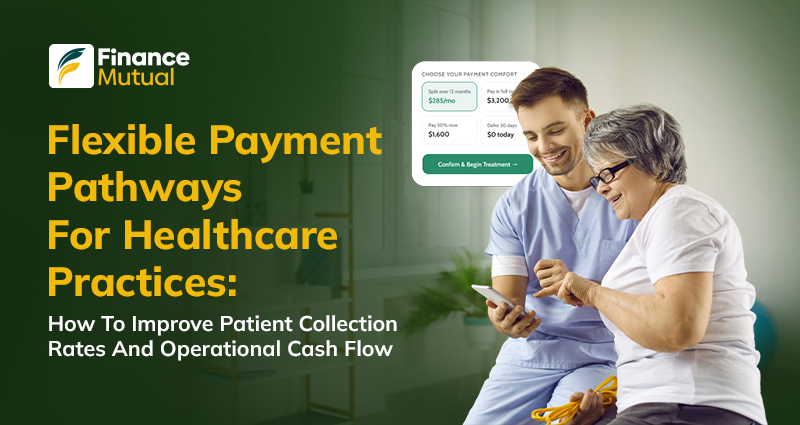
Healthcare practices are caught in a crisis that impacts their bottom line every day. When patients encounter rigid payment options—cash only, credit card, or wait-for-insurance—many defer, abandon, or default.
Without flexible payment pathways, patients walk out without getting the care they need. They leave the counter, reschedule, or go somewhere else. Your practice loses revenue before treatment even starts. Add unpredictable cash flow on top of that: practices never know exactly when patient payments will arrive (or if they will), making budgeting, payroll, and growth planning feel like guesswork.
What if payment options were the lever to reduce write-offs and improve predictability?
Building a Flexible Payment Experience for Healthcare
Patient expectations have changed. They expect flexibility everywhere, in every service they use. They expect to pay later, to split payments, to use financing. When healthcare practices offer only rigid options, it feels outdated.
The reality: Patients have choices. If your practice doesn't offer payment flexibility, they'll go to one that does. Your competitor across town offers payment plans. Your competitor online offers financing. If you only take one payment method, you lose—not just the payment, but the patient.
Building flexibility isn't complicated. It means:
- Offering payment plans for larger treatments
- Integrating financing partners for out-of-pocket costs
- Accepting digital payments (online, mobile, contactless)
- Making it easy for patients to choose at the point of sale
When you do this, you're not just collecting revenue differently. You're removing the barrier between the patient who needs care and the patient who gets it.
What Are the Benefits of Offering Optimized Payment Pathways for Healthcare?
When you build payment flexibility into your practice, everything improves.
- More Patients Complete Payment: Patients are more likely to say yes and move forward with treatment when they have options. No more walking out the door. No more rescheduling. Payment happens—on terms that work for them.
- Revenue Comes in Faster: Digital payments, automated reminders, and clear payment plans mean cash flows into your account sooner. No more waiting 45-90 days for collections. Your cash flow becomes predictable.
- Less Manual Work for Staff: Fewer manual follow-ups. Fewer phone calls. Fewer people needed in billing. Instead of chasing invoices, your team focuses on patient care and practice growth.
- Fewer Bills Go Unpaid: When patients have realistic payment options and clear upfront costs, fewer balances disappear. You lose less money to write-offs and bad debt.
- Better Patient Experience: Patients feel respected when you meet them where they are. Modern, easy payment options make your practice feel professional and up-to-date. Patients are happier and more likely to come back.
- You Stay Competitive: Patients expect flexibility. Practices without it lose patients to competitors who offer it. Payment flexibility isn't a bonus anymore—it's the baseline.
Knowing the benefits is one thing, but how do you actually bring this flexibility into your daily operations? It comes down to opening up different digital channels so patients can pay on their own terms.
The Modern Patient Experience: Healthcare Digital Transaction Pathways
Building flexibility means offering multiple pathways. Here's what works:
- Payment Plans: Break high costs into monthly payments over 6-12 months. Patients pay interest-free and manage it through a simple online portal. No guesswork, no surprise bills.
- Third-Party Financing: Partner with medical financing companies to offer patients specialized loans or zero-interest financing. The practice gets paid upfront. The patient pays over time.
- Digital Wallets & Omnichannel Payments: Accept tap-to-pay, QR codes, Apple Pay, Google Pay, and online checkouts. Make it easy for patients to pay however they're comfortable.
- Patient's Own Accounts: Many patients have Health Savings Accounts (HSAs) or Flexible Spending Accounts (FSAs)—tax-advantaged accounts for medical expenses. Make it easy for them to use these funds.
- Medical Credit Cards: Specialized financing cards offer promotional zero-interest periods if the balance is paid within a set timeframe. Good for larger treatments.
- Insurance: Of course, most patients use private or government-sponsored insurance. Make sure your system routes insurance payments correctly and shows patients their true out-of-pocket cost upfront.
Which Payment Alternatives Work for Which Specialties
Not all payment options work the same for every practice. Some specialties deal with high-cost procedures. Others handle recurring visits. Some rely heavily on insurance. The payment methods that work best depend on what your patients need and when they need it. Here's a quick guide:
| Specialty | Best Payment Options | Why It Works |
| Dental | Payment plans, Medical credit cards, Digital wallets | Procedures range from $200 to $5,000+. Patients expect flexibility for cosmetic or major work. Medical credit cards are used to finance elective procedures like veneers or implants. Digital wallets capture routine payments quickly. |
| Orthopedic | Third-party financing, HSA/FSA, Insurance routing, Payment plans | Procedures are high-cost and scheduled in advance. Patients have time to explore financing options. Insurance may not cover everything. Many patients have HSA/FSA funds set aside for these expenses. |
| Cosmetic & Aesthetic | Medical credit cards, Third-party financing, Payment plans | Procedures are typically elective and cash-based. Patients expect financing and often shop around. Zero-interest promotional periods are popular. Payment plans let patients afford larger procedures. |
| Physical Therapy & Wellness | Payment plans, Digital wallets, HSA/FSA | Services are often recurring and moderate-cost. Payment plans work well for ongoing treatment packages. Digital wallets speed up frequent small payments. Patients often use HSA/FSA funds here. |
| Healthcare Services (Primary Care, Specialty Clinics) | Insurance routing, Payment plans, Digital wallets | Most visits are insurance-covered. Focus on clear patient responsibility statements and easy payment for copays and deductibles. Payment plans help patients with high deductibles. |
Note: This is for informational purposes only.
How FinanceMutual™ Enables Payment Choice Without Complexity
FinanceMutual™ is a patient payment experience platform built specifically for healthcare. It removes the awkward payment conversation entirely—instead of staff asking patients how they'll pay, the platform uses adaptive patient intelligence to personalize checkout for each patient, showing them options that match their specific situation.
The customizable checkout matches your brand and tone and reaches patients wherever they are: via SMS, email, QR codes, on your website, or via shareable links. It integrates seamlessly with your existing practice management software and EHRs, so no disruption to your workflow.
Conclusion
Payment flexibility isn't a luxury anymore—it's the expectation. Patients expect to pay their way. When you give them that choice, everything changes: more patients move forward with care, money comes in faster, and your staff focuses on what matters.
The path is clear. Start by understanding what your patients need—high-ticket elective care requires financing options; recurring services need payment plans; insurance-heavy practices need clear billing. Then build the infrastructure to deliver those options at every touchpoint: at the counter, via text, online, however your patients prefer to engage.
FAQs
1. What Are Flexible Payment Pathways for Healthcare?
Flexible payment pathways refer to offering patients multiple ways to settle their medical bills. Instead of limiting patients to a single payment method, you offer several options, including payment plans, financing partners, digital payment tools, and tax-advantaged account integrations. This broadens your patient base and improves the likelihood that patients complete their treatment and pay in full.
2. How Do Flexible Payment Pathways Improve Patient Collection Rates?
When patients encounter payment options that suit their financial circumstances, they're more likely to proceed with care rather than postpone or seek alternatives elsewhere. Offering variety at checkout removes a major barrier to completing transactions. This leads to stronger collection performance and reduces the percentage of unpaid invoices.
3. How Do Healthcare Digital Transaction Pathways Help with Cash Flow?
Digital-first payment channels allow immediate settlement without manual processing delays. When patients can pay instantly via text, QR code, or an online portal, funds enter your account faster. Automation also reduces the administrative work required to follow up on unpaid balances, freeing up staff bandwidth and improving overall cycle time.
4. Do I Need to Overhaul My Practice Management System to Adopt Flexible Payment Pathways?
Not necessarily. Modern payment solutions are designed to complement existing systems rather than replace them. Most integrate with the practice management software and patient records already in use, minimizing disruption and eliminating the need for complex IT projects.
5. How Do Healthcare Alternative Payment Pathways Affect How Patients Perceive My Practice?
Patients interpret payment flexibility as a sign of modern, patient-centered operations. It signals that the practice values their circumstances and isn't creating unnecessary obstacles. This perception builds trust, encourages positive word-of-mouth, and strengthens patient loyalty over time.