






The rapid evolution of digital health has brought incredible convenience to our lives, but it has also brought a flood of industry jargon. If you’ve found yourself scratching your head trying to figure out the difference between a virtual check-in, a digital consult, and a remote screening, you are far from alone.
People—and even many healthcare organizations—frequently use terms like "telehealth," "telemedicine," and "virtual care" interchangeably. However, they aren't just different words for the same thing. They mean fundamentally different things structurally, legally, and clinically.
Understanding these vocabulary shifts is more than just a lesson in medical semantics. Whether you are a provider trying to navigate insurance reimbursements or a patient trying to access the right digital portal, drawing a clear line between these technologies is the key to navigating the modern virtual healthcare landscape effectively.
What’s Telehealth? A Foundation for Modern Care
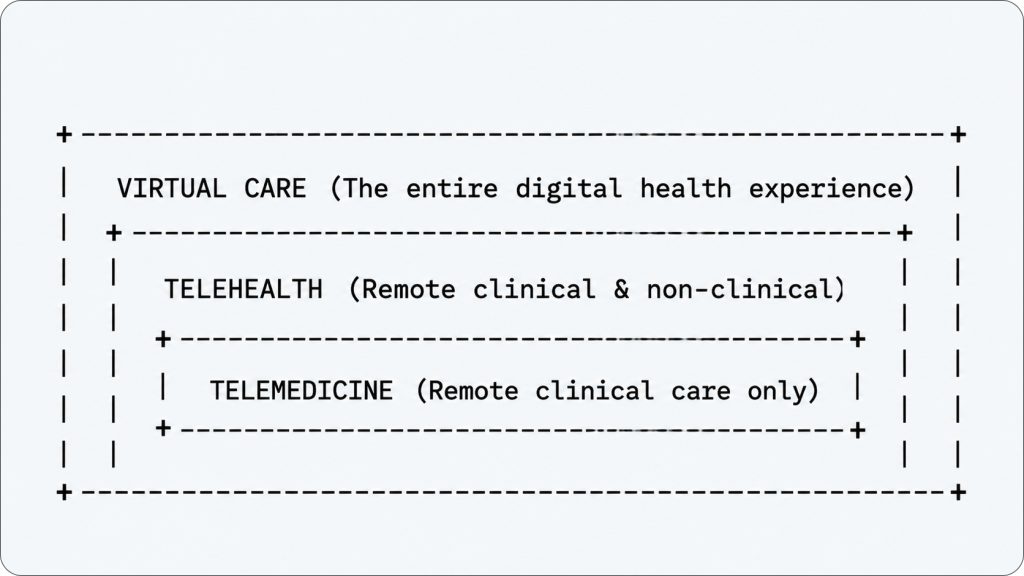
Telehealth is the umbrella. It covers the full range of technology used to deliver health-related services, education, and support remotely — clinical and non-clinical alike.
That includes administrative meetings, public health tracking dashboards, online training for doctors, patient education portals, and wellness apps. None of that requires a clinician actively diagnosing or treating anyone. It's infrastructure and support, not a medical encounter.
Decoding Telemedicine: The Tele Medical Abbreviation and Common Telemedicine Types
The prefix "tele" originates from the Greek word for "distant" or "at a distance". When fused with "medicine" (derived from the Latin medicus, meaning a physician or healer), the term literally translates to "healing from a distance."
Telemedicine is a specific subset of telehealth. It refers strictly to remote clinical services where a licensed healthcare provider diagnoses, treats, or monitors a patient from a different location.
Quick Summary
If a doctor is examining, diagnosing, or prescribing medication to a patient virtually, it is telemedicine. If it involves general health administration, technology frameworks, or medical education, it is telehealth.
The Three Types of Telemedicine
| Type | How It Works | Common Uses |
| Synchronous (real-time) | Patient and provider connect live, via video or phone | Primary care check-ins, telepsychiatry, urgent care triage |
| Asynchronous (store-and-forward) | Data or images are sent and reviewed later, no live interaction | Dermatology photo review, radiology interpretation |
| Remote Patient Monitoring (RPM) | Connected devices send physiological data straight to the clinic | Diabetes management via CGM, hypertension tracking, post-surgical cardiac monitoring |
Telehealth and Telemedicine Difference: The Direct Comparison
The fastest way to separate them: telehealth is the system, telemedicine is one clinical function inside it.
| Telehealth | Telemedicine | |
| Scope | Administrative, educational, and clinical | Strictly clinical |
| Who's involved | Administrators, educators, developers, patients tracking general wellness | Licensed providers and the patients they're actively treating |
| Example | A staff webinar on a new EHR system | A live visit to diagnose a sinus infection |
Widening the Lens: Telemedicine vs Virtual Care
Virtual Care is the overall umbrella term for any interaction or service where healthcare is delivered digitally using technology. It spans everything from live video doctor appointments to remote health tracking, secure portal messaging, and digital wellness tools.
Telemedicine is a specific clinical subset of Virtual Care. While telemedicine focuses strictly on remote doctor-patient clinical care (diagnoses and treatments), virtual care is the overarching term for all digital technology used to deliver healthcare, both clinical and non-clinical.
| Feature | Telemedicine | Virtual Care |
| Scope | Narrow (Clinical medical services) | Broad (The entire digital health ecosystem) |
| Goal | Diagnosing, managing, and treating illness remotely | Delivering continuous care and health management digitally |
| Examples | Video consultations, digital prescriptions, specialist visits | Patient portals, remote monitoring, health apps, telemedicine |
| Who delivers it | Physicians, Nurse Practitioners, Physician Assistants | Clinical staff, care navigators, wellness coaches, administrative teams |
| Interaction Style | Mostly live (synchronous) video or audio visits | Live visits + continuous, automated, or asynchronous digital tools |
Understanding the Telecare Definition and Remote Support
Telecare isn't about diagnosis at all — it's about safety. Sensors, alarm pendants, fall detectors, and monitoring systems that let people, often older adults or those with chronic conditions, live independently at home.
Where clinical medicine treats illness, telecare is built around one thing: keeping someone safe enough to stay in their own home, with help a button-press away.
The Next Frontier: Telehealth and Mobile Health Integration
A traditional doctor visit is a snapshot — one appointment, a few vitals checked, done until next time. Pair telehealth with mobile health (mHealth) and that snapshot becomes a continuous feed.
mHealth covers the everyday tech people already use to track their health: phone apps logging steps or meals, wearables like an Apple Watch or Oura Ring, and specialized sensors like continuous glucose monitors.
Here's how the two connect in practice:
- A wearable quietly collects data throughout the day.
- That data gets sent securely to the patient's health record.
- Software turns raw numbers into a trend a doctor can actually use — resting heart rate up 10% this week, for instance.
- If something's off, the care team reaches out or schedules a virtual visit before it becomes a bigger problem.
Conclusion
While terms like telehealth, telemedicine, virtual care, and telecare are often used interchangeably, understanding their unique definitions helps clarify the modern healthcare landscape. Whether it is managing broad health systems or delivering targeted remote clinical care, these digital health innovations all share a common ultimate goal: expanding healthcare accessibility, streamlining delivery, and significantly improving patient outcomes.
Turn Better Patient Experiences
Into Better Outcomes.
See how FinanceMutual™ can transform the patient financial journey while helping your practice deliver a better experience.
Book Your Demo →FAQs
1. What is telehealth and how does it work?
Telehealth encompasses the entire digital framework for remote healthcare delivery, including both clinical services and non-clinical tasks such as patient education portals, staff training, and public health tracking dashboards.
2. What is the primary telehealth and telemedicine difference?
The main difference between telehealth and telemedicine comes down to scope. Telehealth serves as an overarching umbrella for all health-related technology, whereas telemedicine focuses strictly on active remote medical care provided by licensed clinicians.
3. How do telemedicine vs virtual care compare?
When evaluating telemedicine vs virtual care, virtual care covers the entire spectrum of digital doctor-patient interactions. Telemedicine is the specific clinical branch dedicated to diagnosing and treating illnesses remotely.
4. How is the telecare definition distinct from clinical treatment?
The telecare definition centers on safety, independent living, and emergency monitoring—utilizing tools like fall sensors and call buttons—rather than active medical treatment or clinical diagnosis.